Asia has been called the next great economic story for decades, and for decades it has not quite arrived. Jason Ne Win thinks stablecoin payments in Asia could be where that changes. In his view, the region already carries most of the world’s stablecoin activity, yet stablecoins are still only about 1% of real money. That gap is the reason he left one of the biggest jobs in crypto.
At TOKEN2049 Singapore, The Blockopedia sat down with Jason, CEO of Asia-Pacific (APAC) at Mesh, for the TBP Podcast. Over about 15 minutes, they covered his five years as chief of staff at Binance, why he moved to Mesh, the numbers behind his optimism about APAC, his three priorities for the region, what Mesh’s partnerships mean for an ordinary user, and how he thinks about work, careers and growth.
Key Takeaways
- Jason spent five years at Binance as chief of staff to two CEOs, Changpeng Zhao (CZ) and Richard Teng, before joining Mesh in 2026 to lead its growth in Asia-Pacific.
- Mesh describes itself as an orchestration platform. It connects exchanges and wallets so that crypto can be used to pay merchants and partners such as PayPal, Shift4 and Kalshi.
- Jason says APAC makes up about 60% of global stablecoin volume and has five to seven of the world’s top 10 countries for crypto adoption.
- With the stablecoin market at around $400 billion against tens of trillions of dollars in traditional money, he says stablecoins are only at “the 1% mark”.
- His three priorities are a local team, the new SBI, Money Forward and Mesh joint venture in Japan, and country-by-country localisation. His personal target is for APAC to reach 40% to 50% of Mesh’s business.
- For everyday users, he says nothing should change on the surface. The gain is real-time, T+0 stablecoin settlement in the background, with cost savings passed to merchants and then to users.
Who is Jason Ne Win?
Jason introduced himself simply as “Jason from Mesh Pay”. Before Mesh, he spent five years at Binance, which he joked “seems like 15 years in crypto years”. There, he served under two leaders he calls “amazing bosses and mentors”, CZ and Richard Teng.
According to Mesh’s announcement of his appointment in April 2026, Jason was chief of staff to both CEOs. Alongside that role, he led global government relations, enterprise strategy and planning, central project management and crisis response. Mesh named him its first CEO of APAC, based in Singapore, to lead the company’s expansion across the region.
He described Mesh as a startup valued at $1 billion that began about six years ago and closed its Series C this year. On the public record, Mesh announced a $75 million Series C in January 2026, led by Dragonfly Capital, with Paradigm, Moderne Ventures, Coinbase Ventures, SBI Investment and Liberty City Ventures taking part. The round valued the company at $1 billion and brought its total funding to more than $200 million.
What Mesh actually does
Jason calls Mesh “essentially an orchestration platform”. On one side, it connects exchanges such as Binance, Coinbase, Kraken, Crypto.com and Bybit, along with crypto wallets. On the other side, it adds what he calls “a layer of utility” that lets users of those platforms pay into clients and partners. He named PayPal, Shift4 and Kalshi as examples.
His own summary is short: “Essentially we’re building the plumbing and the rails for crypto to flow better globally.”
In practice, this means a person holding crypto on an exchange or in a wallet does not need to move funds manually between platforms to pay for something. Mesh sits in the middle and handles the connection. Mesh says the same network lets merchants receive settlement in the stablecoin or local currency they prefer.
Why he left Binance for Mesh
The first question was the obvious one. Why leave the world’s biggest exchange for a payments startup?
Jason did not play it down. “It was a tough decision. It was a tough and emotional decision,” he said, calling it one of the most emotional turning points of his life. He referred to a Chinese saying about remembering the well you drank from, and said he will always be grateful to Binance, to CZ, to Richard and to everyone else there. “I would not be where I am today without all of that effort and mentorship and guidance,” he said.
What pulled him to Mesh came down to three things.
First, Asia-Pacific itself. Jason wanted to focus on APAC and on ASEAN, the Southeast Asian bloc, because he believes the region has huge untapped potential. “We have talked about ASEAN’s potential, APAC’s potential, for decades,” he said. “We were meant to be economies rivalling the G7. We are sort of growing, but we’re not there.” He wanted to spend his time closing that gap.
Second, the technology shift. He sees blockchain and crypto as a basic change in how value and money move, in the same line as the internet, mobile and cloud before it, and alongside AI today. He was frank about AI. Asia has world-class chip companies in Taiwan and South Korea, he said, but it may be hard for the region to produce a world-beating AI company beyond what the current leaders are doing. Blockchain is different. “For blockchain, for crypto, I think it is APAC’s to win,” he said, “and I want to be part of that fabric.”
Third, the company. He wanted to join an earlier-stage, fast-growing company with a strong team, which he says Mesh is.
He closed the answer the way he opened it: the move was not made lightly, and he is where he is today “because of what Binance gave to me”.
Stablecoin payments in Asia: the case in numbers
Asked what real potential APAC has, Jason listed the data points behind his confidence. These are his figures from the interview.
- Stablecoin volume. APAC makes up about 60% of global stablecoin volume. “It already is bigger than most of the world,” he said.
- Crypto adoption. By his count, APAC has five to seven of the top 10 countries in the world for crypto penetration.
- People. The region has the largest middle-class and youth populations. By 2030, he expects APAC to hold about 60% of global middle-income purchasing power.
Then came the number he returns to most. The total stablecoin market cap is around $400 billion, he said, while the market for real money, the dollars, yen and other currencies traded in foreign exchange, runs into the tens of trillions of dollars. “So we are at the 1% mark,” he said.
His conclusion is that the headroom is enormous. Even if Mesh did nothing, he argued, the market could grow 100 times from here. “Obviously I’m going to do something. I’m going to do more and grow faster,” he added. “That’s the true potential, and I think it’s ours to take: APAC and Mesh.”
Mesh’s three priorities in Asia-Pacific
Asked for his top three initiatives, Jason first asked whether he could give ten, then kept it to three.
1. Build a local team first
He starts from what he calls first principles: hire the right people. That means people who know the region, who understand localisation, and who can build for local habits and user behaviour. In a few months, the APAC team has grown from just Jason to five people. “All of them are superstars,” he said.
2. The SBI, Money Forward and Mesh joint venture in Japan
The second priority was brand new at the time of recording. “We just announced this yesterday, actually,” Jason said: SBI, Money Forward and Mesh are forming a joint venture in Japan, and “we’re going to launch soon”.
According to the companies’ announcement of 7 October 2026, SBI Holdings, Mesh Connect and Money Forward have reached a basic agreement to set up Mesh SBI Money Forward Network KK. Mesh is to hold 60%, the SBI Group 26% and Money Forward 14%. The venture is planned for 2026, subject to final agreements, internal approvals and any required work with regulators. It aims to make it easier to buy, transfer and pay with digital assets through API connections, and to build on-chain payment infrastructure for the Japanese market.
For Jason, the venture shows what localisation should mean. It is not about “exporting a product from the US and then copying and pasting into the region”, he said. It is about understanding what users really need and where the friction is, “per market, per flow, per transaction”, and then solving for that.
3. Treat Asia country by country
The third priority takes localisation further. Asia is not one market. Japan’s user behaviour differs from South Korea’s, which differs from India’s and Vietnam’s, he said. “We need to build for the users, build for the region, build for the country.”
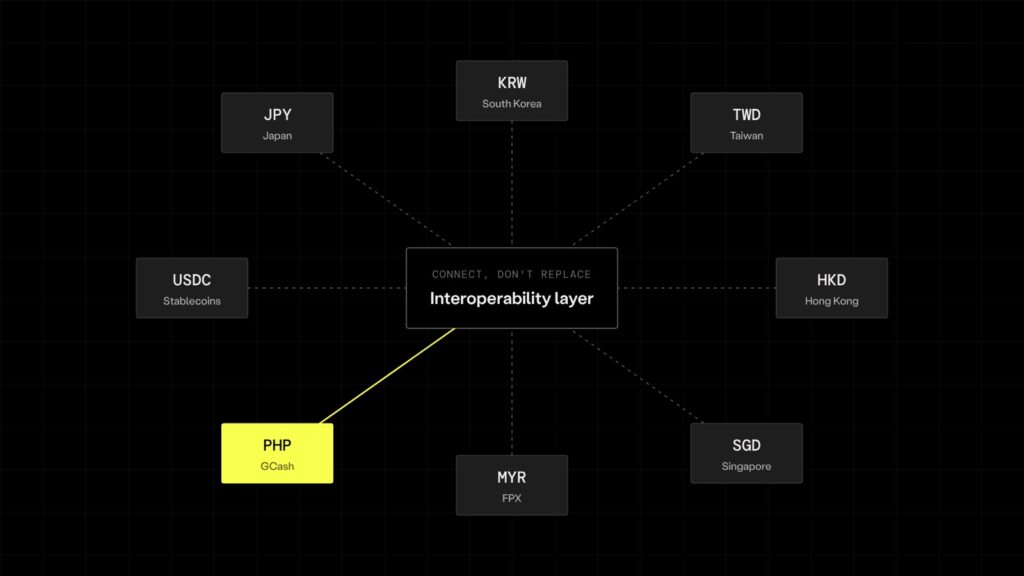
He also set a bold target. When US and other international companies expand into Asia, he said, the region usually ends up as 5% to 15% of their global business. Neither he nor Mesh’s leadership is interested in that. “Asia should be the crown jewel in Mesh, and Asia should actually be the crown jewel in any international company,” he said. His goal is for APAC to make up 40% to 50% of Mesh’s growth and volume. He told the company 30%, he admitted, but has set himself a higher target.
What changes for an everyday user?
Much of Mesh’s work happens in business-to-business partnerships. So what does any of it change for a retail user?
“At the highest level and at the most basic level, nothing should change,” Jason said. Mesh does not want people to change how they pay. “We just want it to be simpler and faster.”
If you are used to taking out your phone and scanning a QR code to pay, you keep doing exactly that. The change happens in the back end, where stablecoins move the money. Jason described this as a move away from “ledger-based, pseudo real-time settlement” to actual real-time settlement, known as T+0, meaning settlement on the same day the payment is made.
The result, he said, is that things become more efficient, cheaper and faster. The cost savings go to the merchant first and then to the customer. “The work happens behind the scenes, the partnerships happen behind the scenes, the operations happen behind the scenes,” he said, “but then for you and I, things just get better.”
Work-life integration, not balance
Asked how he balances work and life after five demanding years at Binance, Jason gave an honest answer. “I’m not really a believer in work-life balance. I don’t think that works,” he said. If you are truly passionate about getting something done, a strict nine-to-five does not fit, though he accepts that everyone is different.
Instead, he follows what he calls work-life integration. His phone is always with him, and his laptop comes on holidays. But the rule cuts both ways. “When I’m with my wife, I’m with my wife,” he said. At dinner, the phone goes face down and stays there. If he has an hour free afterwards, he opens the laptop and takes some calls. Holidays work the same way.
He also believes work gives people meaning. Going deep into a problem, solving it and feeling that you add value to the people around you, your company and society is, in his words, “great”.
Advice for a career in Web3
His career advice fits in one line: “You just have got to do the hard things.”
If you want to make a difference and build a good career, he said, join a company, join a team or start something. Then look around and ask what the most difficult problem is that nobody is working on, or that needs solving and is not getting enough effort. Then do it. “You do the hard things and everything comes naturally after that.”
What’s next for Mesh after TOKEN2049
Asked for Mesh’s next three or four initiatives for the coming six months, Jason pushed back on the question itself. He does not think about growth as a list of launches or events.
He explained his approach in three levels. At the top is the north star: “to make payments seamless for everyone, to pay from anywhere, through anything, to anyone”. One level down is what that requires: more partnerships, more activation, more education, more joint ventures and deeper integration. One level below that is the daily work: replying to emails, writing business requirement documents, talking to his team and pushing adoption.
“There’s no overarching master plan,” he said, such as signing 16 joint ventures here or 25 deals there. “Every day, talk to people, solve their problems, move forward.”
Final thoughts
This interview gives a clear view of how one of crypto’s better-known operators sees the next stage of payments. In Jason’s view, crypto succeeds in Asia by staying invisible. Users keep their habits, while the settlement under them gets faster and cheaper. His priorities follow from that: local teams, local partners such as SBI and Money Forward in Japan, and products built country by country.
Some of what he describes is on the public record: his appointment as Mesh’s CEO of APAC, Mesh’s $1 billion Series C valuation and the planned joint venture in Japan. Other points are his own estimates and targets, such as APAC’s share of stablecoin volume, the 100-times growth headroom and the goal of making APAC 40% to 50% of Mesh’s business. Treat those as one builder’s view of where the market is heading.
Watch the full conversation on the TBP Podcast YouTube channel.
Frequently Asked Questions
Q: Who is Jason Ne Win?
Jason Ne Win is the CEO of Asia-Pacific (APAC) at Mesh, appointed in April 2026. He previously spent five years at Binance as chief of staff to its CEOs, Changpeng Zhao and Richard Teng.
Q: What is Mesh?
Mesh is a crypto payments network that connects exchanges and wallets, including Binance, Coinbase, Kraken, Crypto.com and Bybit, so that users can pay merchants and partners with digital assets. Jason calls it an orchestration platform building “the plumbing and the rails” for crypto payments.
Q: Why did Jason Ne Win leave Binance?
He calls it a tough and emotional decision. He wanted to focus on Asia-Pacific and ASEAN, he believes blockchain is a shift that APAC can lead, and he wanted to join an earlier-stage, fast-growing company.
Q: Why does Jason think Asia could lead stablecoin payments?
He says APAC accounts for about 60% of global stablecoin volume, has five to seven of the top 10 countries for crypto adoption, and will hold about 60% of global middle-income purchasing power by 2030. These are his figures from the interview.
Q: What is the SBI, Money Forward and Mesh joint venture?
It is a planned Japanese company, Mesh SBI Money Forward Network KK, announced on 7 October 2026. Mesh is to own 60%, the SBI Group 26% and Money Forward 14%. It aims to simplify buying, transferring and paying with digital assets in Japan, subject to final agreements and regulatory steps.
Q: How will stablecoin payments change things for everyday users?
Jason says users should not notice a change. They can keep paying the way they do today, for example by scanning a QR code, while stablecoins settle the payment in real time in the background. This is an industry view, not investment advice. Digital assets, including stablecoins, carry risks.